
Power
WattageOperating quantifiesa server requires electricity to power all of the raterunning parts – from the server itself to the electronics that maintain your Internet connection or attach external storage disks. When self-hosting, you are responsible for the financial requirements that come with keep all the hardware running.
When paying your power bill, wattage is how we quantify how much energy is being used per second. The power draw of energya transferdevice and acts as the indicator for power usage whenis measured over time – typically expressed as kilowatt-hours or kW/h.kWh. Utility companies offer consistent access to power by the kilo-watt hour, generated from both renewable and consumable fuels.fossil fuels.
Energy can comes from many sources and some are harmful.harmful. Learn more about where your energy comes from.
PersonalSelf-Hosted DevicesServers
ElectronicHome deviceselectronics oftenare providemade to work with standard power outlets and do not require much conscious planning – plug a device in and it just works. Despite this, electronics must have information about their power requirements right on them. This can help estimate how much an always-on computer costs to operate per payment cycle.
Power Consumption
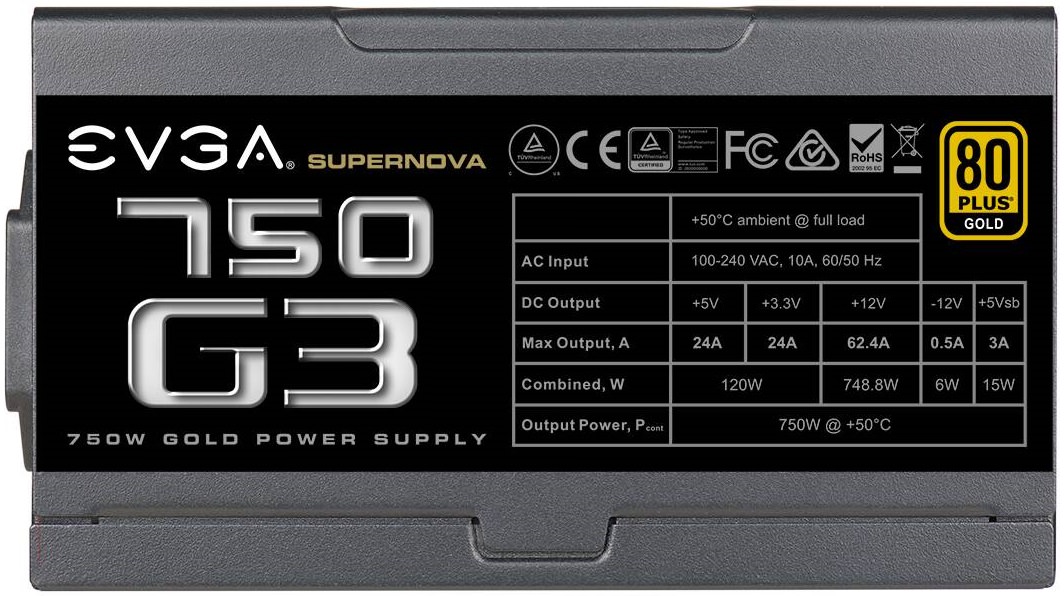
Power Supply Units – or PSUs – provide electricity to individual components within a computer. These specify the wattage that the power supply can draw up to during a heavy work load. This is theonly maximum capacitypossible power draw and doesn'isn't indicatean indication of how much power the computer will consume while idle.
Each component connected to the PSU will need to draw power in order to function and every computer will havehas different parts. The exact amount that each requires can fluctuatefluctuates based on their functionworkload and howthe muchfunction ofbeing performed – converting a workloadvideo therequires component has. Modern computers automatically manage each component'smore power usage,than inputting text into a text editor. An operating system manages power, putting themidle parts to sleep – or a low-power standby mode that conserves electricity.
Servers can draw a lot of power at once and should be plugged directly into a wall socket, not a power strip or extension cable.
CPUs and GPUs generally require the most power, but chipsetsparts designed for laptopmobile candevices beare extremely efficient. By exploring the average power usage for computer components while– both idle and under load,load we–you can estimate how much power ourthe server will consume over the course of a day.
Power Consumption in Watts
| Component |
Idle | Under Load |
| Motherboard | 15 | 25 — 100 |
| Desktop CPU | 10 — 30 | 75 – 250 |
| Desktop GPU | 10 — 50 | 200 – 500 |
| Mobile CPU |
5 — 15 |
15 — 65 |
| Mobile GPU | 10 — 100 | 35 — 150 |
| Hard Disk Drive | 5 | 5 — 15 |
| Solid State Drive | 1 | 1 — 5 |
| RAM module | 2 | 2 – 5 |
UsingThese thesenumbers numbers,are wethe can estimate how muchinstantaneous power ourusage serverby will consume at any one moment. Modern desktopthe computer systems– consumemeasured aroundin 100 watts while idling. While basic office PCs may require 250 watts for web browsing tasks, a machine could draw up to 800 watts while playing a graphics-intensive video game.watts. These estimates are a helpful baseline, but power requirementsdraw will fluctuate. When not actively in use, a modern system might consume around 100W. Office tasks like browing the web or writing an email may require 250W, while a graphic-intensive video game could draw up to 800W.
Want a better idea? Try out pcpartpicker.com and add your exact components.
Computers come in a variety of form factors target at specific use cases. Raspberry Pi computers use specialized processors – like those in smartphones – to create an efficient, lightweight computer. Laptops are designed to be compact, efficient and portable so they can run off batteries.
Mini PCs will often leverage laptop hardware to create a desktop or set-top computer with a small footprint. Traditional desktop PCs range from low-powered office computer solutions to top-of-the-line computer workstations.
When connecting to the Internet, the modem and router also consume electricity that needs to be accounted for. Like a computer, these devices will also draw more power when under a heavy load.
Graph comparison of device wattagewattagehgn nc ç.
Power Consumption in Watts
| Device | Idle | Under Load |
| Raspberry Pi 5 | 3 | 3 — 7 |
| Laptop | 5 | 30 — 200 |
| Mini PC | 5 — 20 | 20 — 400 |
| Desktop PC | 35 — 100 | 150 — 300 |
| Workstation | 75 — 150 | 300 — 800 |
| Wi-Fi Router | 5 | 5 — 20 |
| Modem | 5 | 5 — 20 |
Want to be exact? Try out a digital power meter to find your exact energy usage.
Cost Estimates
Once we have a better idea how much energy we'll require – in the form of wattage – we can estimate how much power the computer consumes while left on over an entire day.
Don't want to do math? Try out this wattage calculator from EnergyBot.
We calculate this by multiplying the total wattage we estimated by the number of hours a day the server will be drawing power. This will be 24 hours per day. We now have our wattage per hour. Finally, we can divide this number by 1000 to achieve our kilowattage per hour.
E(kWh/day) = P(W) × t(h/day) / 1000(W/kW)
A 200 watt Mini PC will use 4.8 kWh per day – or 144 kWh per month – when left running all day, every day.
Now that we know the kilowatt hours consumed by our computer, we can get an estimate the monetary cost per day. Your utility provider will list the exact unit price per kW/h on your account summary or service bill. The cost of energy varies widely across the country – depending on a host of factors – and ranges all the way from $0.10 to $0.43. Residential energy rates are often higher than commerial prices due to the economy of scale.

With this information, it's simple to calculate a monetary cost. By multiplying the cost per kilowatt by the quantity of kilowatts, we arrive at the final cost. When estimating per month, we can see how much our server affects our monthly bill.
Energy costs $0.12 per kWh in Washington State and a 200 watt computer uses 144 kWh over 30 days. This means that it costs $17.28 per month to run an always-on server.
By choosing to self-host, we not only retain digital autonomy but can take better stock of our effect on the ecosystems around us.
Data Centers
Large-scale data centers use exponentially more power than a home server – consuming up to 100 times more than a standard office building. For example, a small data center with 500 servers may require 1 megawatt of power – equivalent to 200 American households.
Data Center Scale
Describe and illustrate difference between w kilowatt and megawatt
Similar to personal computers, data centers can enter idle states where they consumes less power. Entire server racks will turn on and off depending on how much work needs to be done. This will result in a data center's power consumption fluctuating.
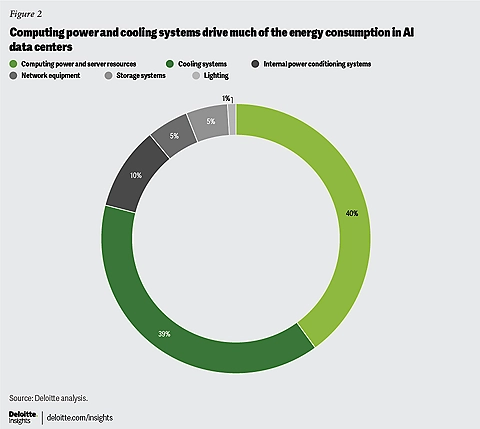
Globally, computer and network technologies are estimated to consume 10% of all energy produced. Of this, data centers consume about 20% – with this expected to continue rising with the rise of machine learning. Two broad categories use nearly 80% of this power: hardware and cooling systems.
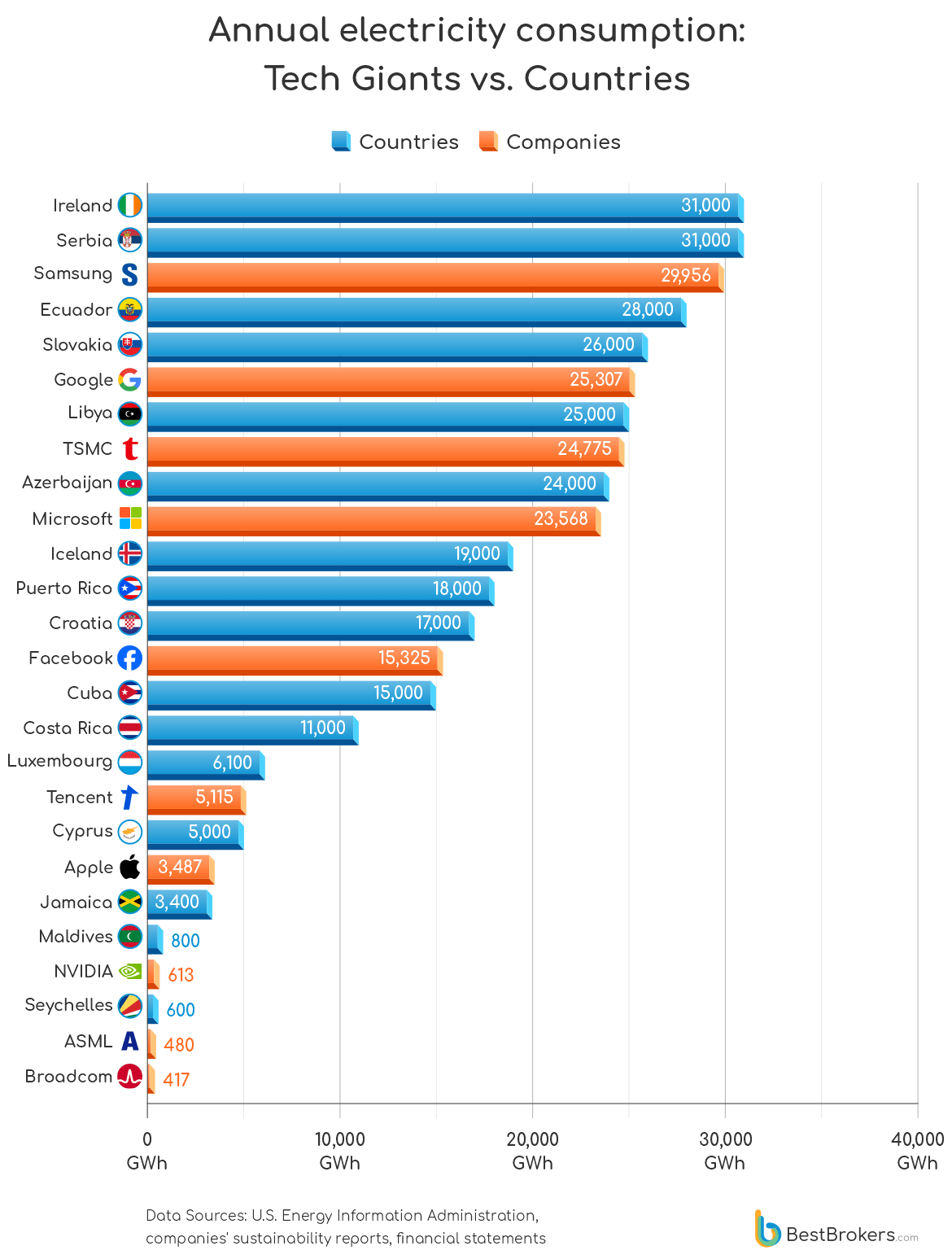
Power consumption for the ten largest global technology companies outpace entire nations.
Data centers are not necessarily bad, but they must be created with care and compassion for the community and ecosystem.